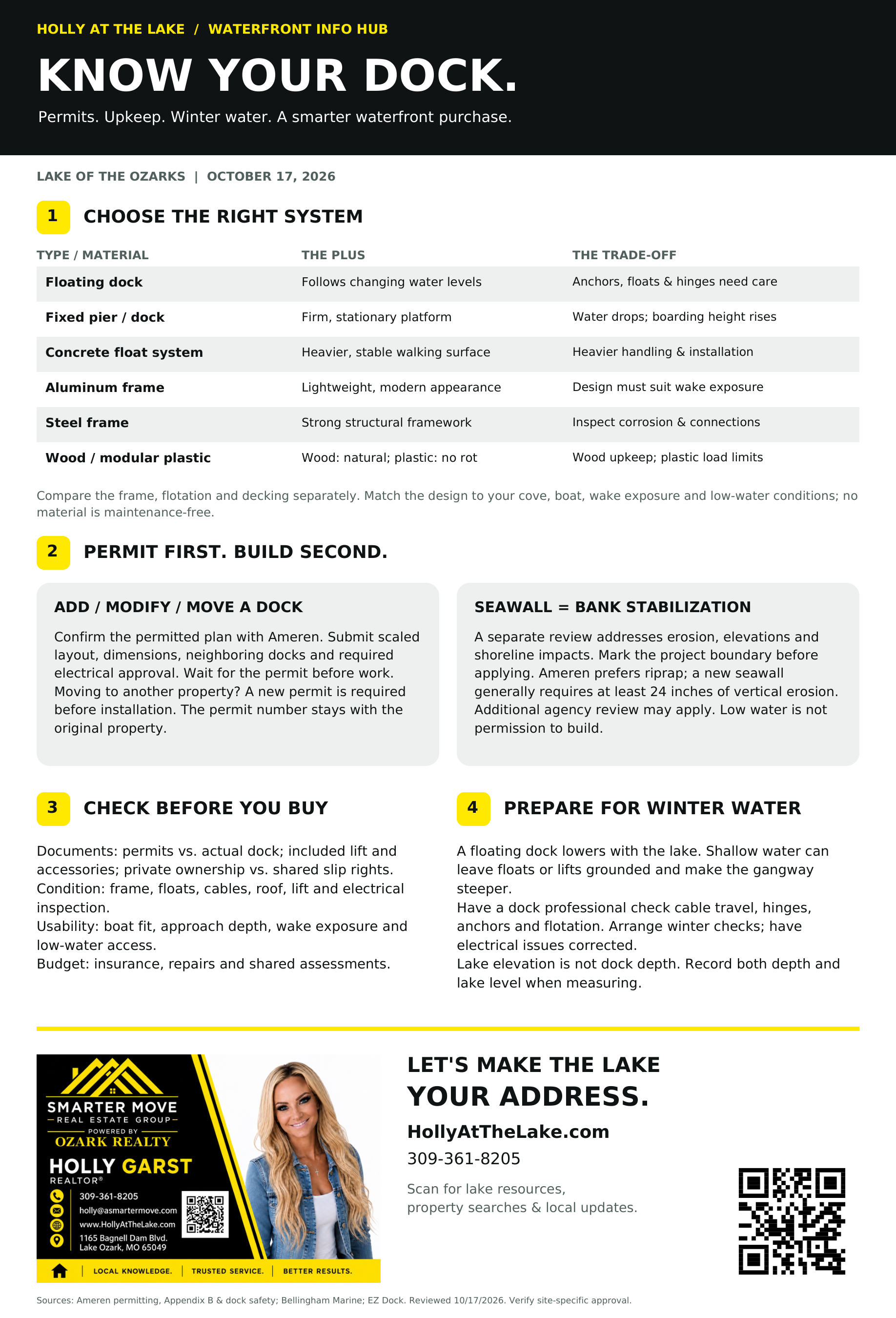
Buying the Lake House? Get to Know the Dock First.
A Lake of the Ozarks guide to dock ownership, maintenance, permits and winter water
October 17, 2026 | By Holly Garst, Realtor®
The kitchen may win your heart, but the dock deserves its own inspection. At Lake of the Ozarks, waterfront ownership means understanding the structure, the water beneath it and the paperwork behind it. A beautiful summer photo cannot answer all three.
Which kind of dock fits your shoreline?
Start with how it is supported. A floating dock rises and falls with the water, helping preserve boarding height relative to your boat. Its trade-off is ongoing attention to flotation, anchoring and moving connections. A fixed pier or dock provides a stationary platform, but its height above the water changes as lake levels change. Local permitting and site conditions determine what is appropriate; a generic dock comparison is not approval to install one. [1, 2]
Next, separate the frame from the floats and decking. A “concrete dock” may describe a concrete flotation system or decking on a framed dock. Ask what is actually included.
| System | Advantages | Trade-offs |
|---|---|---|
| Concrete floating system | Weight provides a steadier walking surface; durable material | Heavier transport and installation |
| Aluminum frame | Lightweight, modern appearance | Select a design suited to the site's exposure |
| Steel frame | Strong structural framework | Ask the inspector to assess corrosion and connections |
| Timber system | Natural appearance; can suit protected water | Inspect wood condition and budget for upkeep |
| Modular polyethylene | No wood rot or splintering in the plastic modules | Confirm capacity, couplers and anchoring suit the intended use |
Manufacturers offer different engineered systems. Compare suitability and service requirements rather than treating a material name as a quality guarantee. [1, 3]
Adding, modifying or moving: ask Ameren before committing
All docks require an Ameren permit before placement. For a proposed addition, modification or relocation, confirm the scope with Shoreline Management, then submit the required layout and supporting documents. Scaled plans identify dimensions, nearby docks, extended property lines and channel relationships. Obtain required electrical approval and wait for the issued permit before work. [2, 4]
Buying a used dock does not buy permission to place it anywhere. A dock moved to a different property needs a new permit before installation. The existing permit number stays with the original property. [4]
Ameren says dock construction, additions, modifications and refoaming must be performed by an Ameren Certified Dock Builder or the property owner. Confirm whether a proposed repair affects the approved design before calling it routine maintenance. [2]
A seawall follows a different review
A seawall is a bank-stabilization project. The project boundary must be marked before applying; plans address elevations and the proposed wall. [4]
Ameren prefers riprap and generally requires evidence of at least 24 inches of vertical erosion before considering a seawall. Its guidelines require an on-site evaluation and, where a wall is permitted, five horizontal feet of riprap at its toe. Seawalls cannot create or reclaim usable land. Replacement walls also have specific requirements; copying the old wall is not automatic approval. Excavation below the waterline creates additional timing and agency considerations. [5]
Winter exposure makes the shoreline easier to see. It does not authorize construction.
What I recommend checking before you buy
Use this as a due-diligence checklist with the appropriate specialists:
- Documents: Does the existing dock match the permitted plan? Request records through the seller or listing agent.
- What conveys: Identify the dock, lift, PWC ports, storage and accessories in the contract.
- Ownership: Is this a private dock or a shared slip? Review assignment rights, maintenance responsibilities and assessments.
- Condition: Have a dock professional inspect the frame, floats, cables, connections, roof, gangway and lift.
- Electrical: Obtain the applicable inspection and have a qualified electrician address defects.
- Boat fit: Verify actual clearances, lift capacity, approach depth and turning room.
- Costs: Request insurance terms and estimates for identified repairs before finalizing your budget.
When ownership changes, the new owner must transfer existing permits. Ameren requires an application, deed, processing fee and applicable electrical approval. Participating fire districts require an approved electrical inspection completed within the preceding 12 months. [4]
Winter drawdown changes how the dock works
Ameren's prior winter guidance described a seasonal level around 654 feet to help manage spring flooding. That is context, not a guaranteed forecast for this winter. [6]
Lake elevation is not water depth. As an illustration, six feet of measured depth at elevation 658 could become roughly two feet at 654 at the same point, assuming unchanged bottom conditions. That does not establish safe clearance for a boat, lift or route.
A floating dock lowers with the lake. Ask your dock professional whether floats can ground safely, whether the gangway can travel freely, and whether the lift and boat retain clearance.
Before winter, have cables, anchors, flotation, hinges and pins checked. Let a professional determine cable adjustments. Secure loose items, correct electrical defects and arrange checks while you are away. Ameren also advises considering safe power shutoff during extended nonuse. [6]
For ongoing electrical safety, Ameren recommends monthly GFCI testing and regular professional inspection of the dock and its power supply. Never reset a breaker or GFCI with swimmers nearby. Repeated trips need investigation. [2]
Let's make the Lake your address
The right waterfront property should fit your boat, your budget and the way you plan to live at the Lake. I can help organize the questions and connect you with the specialists who can answer them.
Holly Garst | Lake of the Ozarks Realtor®
Smarter Move Real Estate Group | Powered by Ozark Realty
309-361-8205 | holly@asmartermove.com
Independent educational summary; not affiliated with Ameren. Requirements and conditions can change. Verify project-specific approval, engineering and electrical needs before work.
Research sources
1. EZ Dock, Floating Docks vs. Fixed Docks, April 9, 2026. Manufacturer guidance; not local permitting authority.
2. Ameren Missouri, Dock Requirements and Safety.
3. Bellingham Marine, Concrete vs. Aluminum vs. Timber Floating Docks, October 10, 2026. Manufacturer guidance.
4. Ameren Missouri, Permitting Information.
5. Ameren Missouri, Appendix B: Lake of the Ozarks Permit Requirements, revision June 30, 2025; particularly bank stabilization, section 6.5.
6. Ameren Missouri, Winter dock preparation guidance, December 2025. Historical seasonal guidance, not a 2026-27 forecast.
Sources reviewed October 17, 2026.